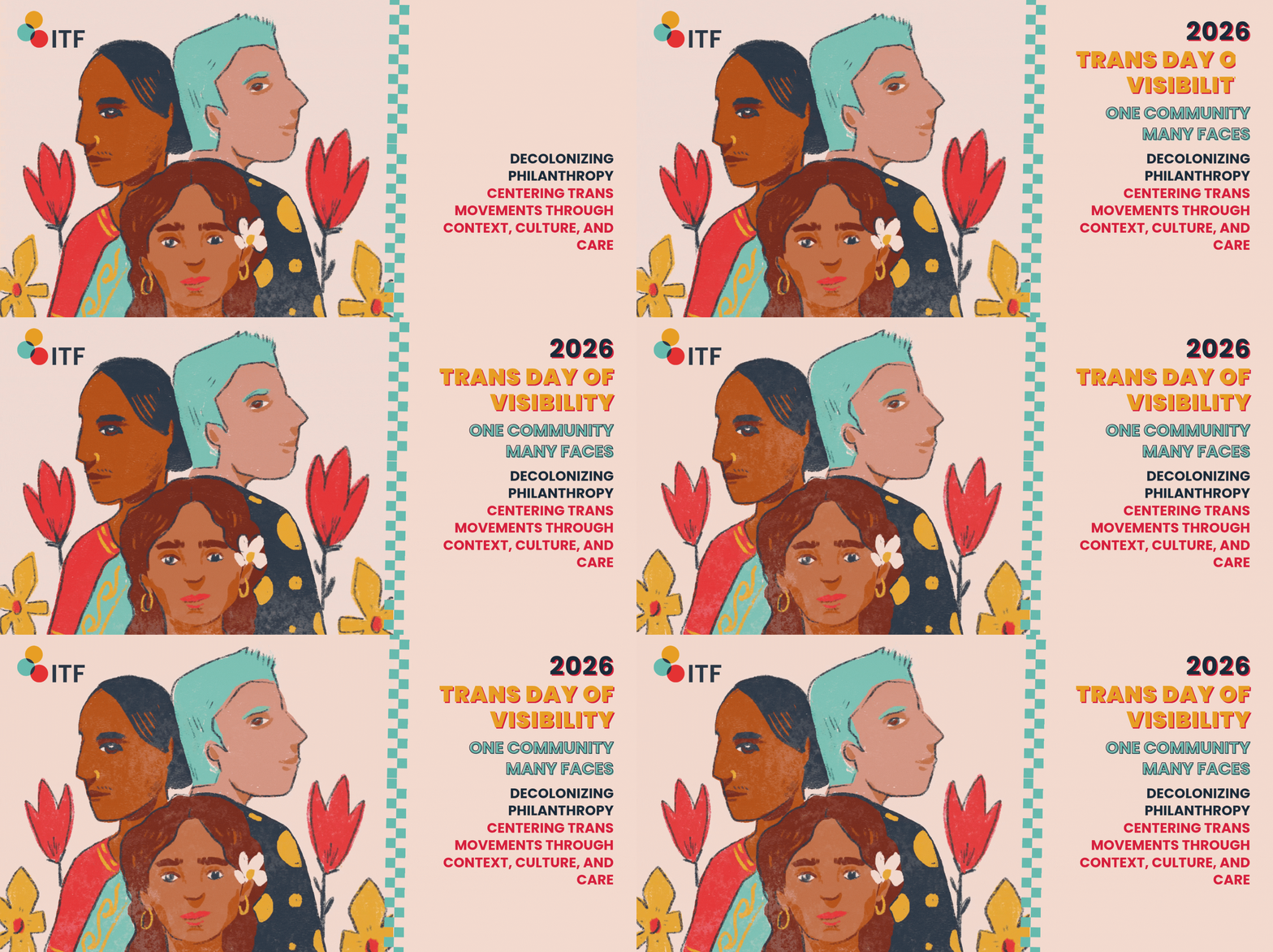
This Transgender Day of Visibility the International Trans Fund (ITF) wanted to bring in a larger understanding of the contexts our grantee partners work in. From a space of curiosity we asked a handful grantee partners about their approach to the trans movement, their local contexts and history. What followed is a glimpse into a largely undiscussed dimension of what it means to build trans movements out of contexts which pre-date a Western understanding of “transgender”.
Across the globe, trans movements are not only resisting violence and exclusion; they are also challenging the very frameworks through which support, funding, and recognition are structured.
At the heart of this challenge lies a critical question: how do funders ensure a decolonial approach to trans movement building?
A decolonial approach to philanthropy goes beyond representation. It requires an honest acknowledgement that all of us working in a global context will always have a partial view, and that getting closer to the full story of the global trans community demands active effort, ongoing collaboration and continuous translation across differences. We must recognize that western-centric models of knowledge, research storytelling, and, funding are continuously shaped by extractive colonial histories. These are legacies that have not ended but have changed form to determine whose voices are resourced, whose knowledge is valued, and whose stories get told.
“As a funder, ITF is not outside of this dynamic. We hold real power: we decide where money flows, whose work gets resourced, and whose does not. But we are actively working to subvert that power. At the core of our work is a commitment to centring lived experience, celebrating cultural knowledge, and upholding community autonomy. We are continuously building practices that put resources, decision-making, and accountability closer to the communities most affected. Respecting the full diversity and complexity of trans lives worldwide is not peripheral to that work. It is the whole point.”
– Broden Giambrone, Executive Director, ITF
Decolonial Practice in Trans Organizing
ITF has had the opportunity of partnering with trans-led groups organizing across vastly different contexts, each bringing their own understanding of what it means to be trans, with definitions that stretch well beyond, and often challenge, the definitions that dominate global discourses. These myriad perspectives have informed our understanding of trans movements, and allowed us to bear witness to lived experiences that are expansive, lush and cosmic in their proportions — alive in ways that no single definition can hold.
For our partners decolonization is not an abstract concept; it is a daily practice rooted in history, survival, and resistance.
In Aotearoa (New Zealand), Rainbow Path highlights how colonization disrupted Indigenous understandings of gender. Māori concepts such as takatāpui which encompass diverse genders, sexualities, and sex characteristics were suppressed under colonial rule, replaced by rigid binaries and pathologizing frameworks.
“As asylum seekers and refugees we know the importance of language and a sense of belonging. Many of us are also indigenous to our country of origin and suffered loss due to colonization. We understand the responsibility we share with all those who have come to live here, to acknowledge Māori as tangata whenua (the people of this land, Aotearoa) and Te Tiriti o Waitangi as New Zealand’s founding document, and to push for constitutional change and decolonization. British colonization trampled on the dignity of takatāpui – Māori whose genders, bodies and sexuality were different to colonial norms.”
To Rainbow Path, a decolonial approach means acknowledging this history, upholding Indigenous sovereignty under Te Tiriti o Waitangi, and resisting narratives that divide migrants and Indigenous communities. For trans asylum seekers and refugees, this work is deeply intertwined with struggles against racism, Islamophobia, and exclusion based on immigration status. Their work keeps the history of their trans ancestors; who have been erased by the land’s colonial past, alive.
In the United States, the Trans Women of Color Healing Project grounds their work in a decolonial lens that recognizes how colonialism, racism, and gender oppression shape the violence faced by Black trans women and gender-diverse people. Their organizing centers community-led decision-making, ancestral healing practices, and the recognition of lived experience as expertise. Rather than relying on external institutions to define needs, they build power internally—reclaiming care, voice, and autonomy.
“Many of the challenges our community faces, violence, stigma, medical mistrust, and economic exclusion, are rooted in systems shaped by colonialism, racism, and gender oppression. A decolonial lens helps us challenge those systems and center the wisdom, dignity, and leadership of Black trans women and gender-diverse people.”
In India, Samabhabona works to centre a decolonial, transfeminist and intersectional approach to trans activism. Samabhabona’s working language, Bangla, is a gender neutral language unlike most colonial languages or Hindi which is a commonly used language across India. Their work is primarily with grassroot trans activists who are rooted in the rich history of ancestral knowledge systems which center a radical approach to collective care.
In 2014, Samabhabona’s founder, Raina Roy, co-authored a paper called Decolonising Trans with trans academic Ani Dutta. This paper highlights how global funding and policy frameworks can impose narrow definitions of “transgender,” marginalizing local identities and lived realities. This directly reinforces the need for decolonial philanthropy that supports context-specific, community-defined understandings of gender.
In Latin America, decolonial practice takes multiple forms, ranging from memory work to epistemic resistance. We spoke to two grantee partners working within the Argentinian context.
Archivo de la Memoria Trans centers its work on community, memory, and lived experience. They prioritise the voices of trans people, particularly older adults who have historically been excluded. Their use of the archive is not neutral, but a political act: a way of recovering erased histories and resisting ongoing marginalization. At the same time, they challenge dominant systems of knowledge production by valuing situated, affective, and community-based knowledge forms. These are often dismissed by traditional institutions but are essential to trans survival and continuity.
Espacio Tolomocho, on the other hand, situates its work within a broader critique of colonial power and knowledge systems. They identify how Western frameworks imposed hierarchical models that privileged white, cisgender, heterosexual men, while erasing Indigenous and other forms of knowledge. They describe this as an epistemicide. For them, a decolonial approach to trans activism means actively dismantling these imposed systems of knowledge, reclaiming subordinated identities and ways of knowing, and centering Indigenous perspectives. In doing so, they affirm a fundamental truth erased by colonialism: that gender has never been limited to a binary.
Language as Resistance and Belonging
ITF firmly believes in Language Justice, and as an organization we try to maintain a multilingual approach to our philanthropy work and all our communications. But it is not merely symbolic. Our team comes from varied contexts of trans lived experiences. Our stories are not anchored in a singular history of transness but rooted in the specific histories, cultures, and languages of the places we come from. That diversity of experience is not incidental to our work at ITF. It is the lens through which we see the communities we serve, and a constant reminder of how vast and varied trans life truly is.
One key dimension of decolonial practice is language. For many,the term “transgender” does not fully capture the cultural, historical, and relational dimensions of gender diversity across contexts.
In Aotearoa, Rainbow Path illuminates the local context for us. Takatāpui is not simply a translation of “trans”; it reflects a holistic identity grounded in what it means to be Māori, in community, and land. Similarly, Pacific identities such as fa’afafine, leiti, or vakasalewalewa carry distinct cultural meanings that extend beyond Western frameworks. The Kupu Māori is a glossary of gender diverse terms explained in English.
Phylesha Brown-Acton, a Niuean fakafifine LGBTQ+ rights activist, originally developed the abbreviation MVPFAFF+ to encourage and facilitate wider use of traditional Pacific terms such as mahu, vakasalewalewa, palopa, fa’afafine, akava’ine, leiti (fakaleiti), and fakafifine. This term is often used to talk about Pacific rainbow people in a collective way, with the + acknowledging the range of traditional and newer Pacific identities.
In the United States, terms like “Fem Queen,” “Femme,” and “Woman of Trans Experience” emerge from Black and Brown queer cultures, particularly ballroom communities. These terms carry lineage, pride, and specificity and center identity and lived experience over clinical categorization. This act of self-authoring, of radical self-love, reclaimed power, and the deep culture of chosen families, resonates in past and present contexts across the world, in which gender nonconforming communities resist(ed) and celebrate(d) their lives.
In India, and South Asia at large, there is an ancient house system known as the gharana. The gharana is its own family system which exists primarily for occupational trans identities such as hijra. This system is centuries old. When the British colonized India, trans people were put under the “illegal tribes” act and they were criminalized; their histories erased. The position of social respect they had was taken away and social stigma has been rampant since.
Organizations like Samabhabona are run by trans activists living in the eastern part of India, in the state of West Bengal. Here secret languages like Ulti are used to communicate within the community to protect each other and lead private lives. Within Ulti, terms like tonna are used for masculine people. The language is also a space of fun and play, and full of inside humour.
India’s context is diverse and there are endless terms for trans people, ranging from koti (encompassing a spectrum of trans feminine identities), kinnar, Thirunangai, aravani and countless others. Among the trans communities Samabhabona works with, there are gajan performers. They are trans feminine people who are engaged in the ancient practice of performing theatre with a social message in the villages of Bengal. All of these show the richness of trans culture that predates the era of colonial rule in India.
Archivo de la Memoria Trans shared that in Argentina the word *travesti*carries significant political and historical weight. It speaks to life trajectories marked by exclusion and institutional violence, as well as by networks of survival and collective organizing.
This was echoed by Espacio Tolomocho:
“In Argentina, “travesti” can refer to a social, cultural, and—at times—professional identity (encompassing work, aesthetics, and community). Its connotations vary depending on the specific context and the individual; it is not always equivalent to “trans” as interpreted in contemporary Western frameworks. It is recommended to listen to each individual regarding which label they prefer to use.”
These diverse terms demonstrate that gender diversity has always existed across cultures—but there is a repeated pattern of colonial systems erasing, criminalizing, or redefining these identities. Reclaiming language becomes an act of resistance and cultural restoration.
ITF’s Role: Enabling Context-Specific Movements
What distinguishes ITF as a funder is its commitment to recognizing that trans organizing is not one-size-fits-all. Grantee partners consistently describe feeling seen and respected in their context-specific approaches.
For Rainbow Path, this means acknowledging that trans asylum seekers and refugees face layered forms of marginalization that cannot be separated from their gender identities. Legal advancements, such as self-determined gender recognition, often exclude migrants, highlighting the need for nuanced, intersectional funding approaches.
For the Trans Women of Color Healing Project, ITF’s recognition of culturally rooted language and practices affirms the legitimacy of their work. At the same time, they stress the importance of trust, consent, and data protection, particularly in a global climate where information about trans communities can be weaponized.
Across contexts, grantees emphasize that being understood is not just about inclusion—it is about safety, dignity, and the ability to define their own realities.
Rethinking Philanthropy
Decolonizing philanthropy requires more than shifting funding priorities. It demands a fundamental rethinking of how knowledge, power, and relationships operate within the funding ecosystem itself.
For ITF, that means:
- Radical curiosity. Approaching the cultures and contexts we work with not as subjects to be understood but as teachers. Staying genuinely open to being changed by what we learn.
- Valuing community knowledge on its own terms. Not simply alongside institutional expertise, but often above it. Lived experience is not anecdotal. It is evidence.
- Embracing plurality. Resisting the urge to standardize. Trans activism looks different everywhere, and that difference is not a problem to be managed but a reality to be respected and resourced.
- Protecting communities, not just data. Ensuring that funding processes don’t extract or expose sensitive information. In a global climate where trans lives are under threat, how we handle knowledge is a question of safety.
- Seeing the full picture. Recognizing that trans lives are shaped by intersecting realities of race, migration, disability, and class (among many other things). Funding that ignores those intersections reproduces the very hierarchies it claims to challenge.
- Building relationships that last. Trust is not built through a single grant cycle. It is built through transparency, consent, and the willingness to show up over time.
Taken together, these are not aspirational values. They are practical commitments that philanthropy can and must make. ITF’s work demonstrates that it is possible to move away from prescriptive, top-down models toward something more responsive, relational, and rooted in genuine accountability to the communities we exist to serve.
ITF’s approach demonstrates that philanthropy can move away from prescriptive, top-down models and toward practices that are responsive, relational, and rooted in justice and trust.
Toward Collective Liberation
Decolonial practice in trans movement building is ultimately about reclaiming what was disrupted; knowledge, language, autonomy, and community. It is about recognising that trans people have always existed, across cultures and histories, and that their ways of being cannot always be contained within Western frameworks.
By prioritising these principles, ITF is not only funding trans movements—it is helping to reshape the conditions under which they can thrive.
In a world where trans rights are increasingly under threat, this approach is not just গুরুত্বপূর্ণ; it is essential.
This article was written and compiled by Ayan A, a communications consultant for the ITF. Ayan co-created the transfuturistic archive imaginingutopias.com which explores trans South Asian and South Asian diaspora’s attempt to use fiction to reclaim lost trans histories to colonial violence and erasure.